


Deterministic Multi-Agent Orchestration: Architecting LangGraph with Enterprise RAG Pipelines
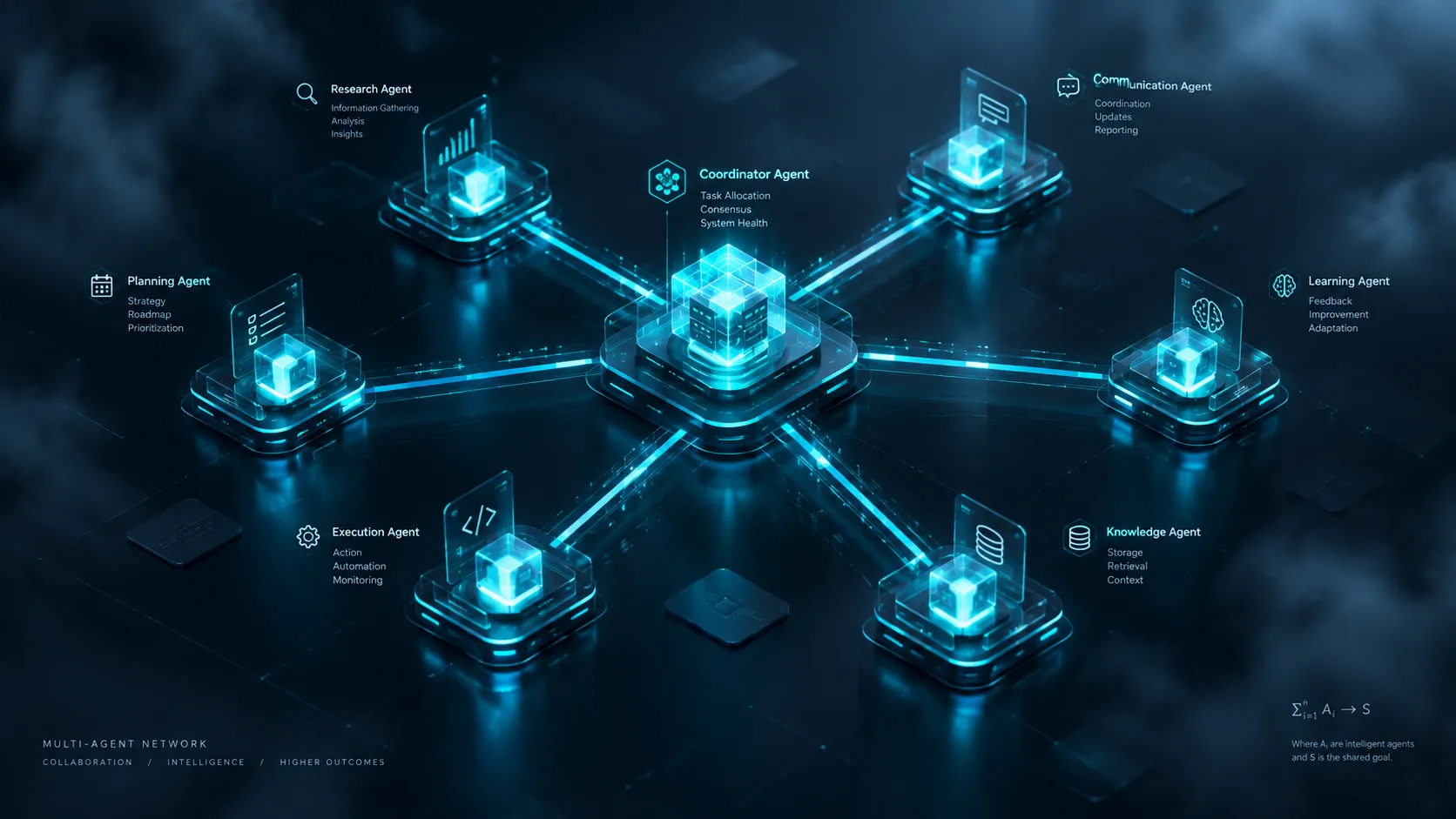
Introduction — The Problem with “Smart” AI
In 2023, the AI industry discovered that large language models could generate impressive answers. In 2024, it discovered something more important:
Impressive is not the same as trustworthy.
In enterprise environments — finance, healthcare, legal, insurance, ERP — an AI system that is “usually right” is not acceptable. A hallucination is not a quirky output. It is:
A compliance violation
A financial risk
A legal liability
A failure of the system itself
Yet most “AI solutions” in production today are still built on a fragile foundation:
User Prompt → [Single LLM Call] → Response
This architecture has no retrieval grounding, no validation layer, no audit trail, and no way to reason about why an answer was produced. It is a black box with a chat interface.
This article is about a fundamentally different approach:
Deterministic multi-agent orchestration — where every step is defined, every output is grounded, and every decision is auditable.
Part 1 — Why “Prompt Engineering” Is Not an Architecture
Prompt engineering is a useful craft. It is not an architectural discipline.
The problems with prompt-only systems in enterprise contexts:
| Problem | Business Consequence |
|---|---|
| No grounding | Model invents facts not in the knowledge base |
| No validation | Errors pass through undetected |
| No state | Each interaction starts from zero |
| No auditability | Cannot explain how an answer was produced |
| No tool boundaries | Model may invoke actions it shouldn’t |
| No determinism | Same input may produce different outputs |
In an enterprise system, “the AI said so” is not an acceptable answer. The question is: how do we know?
Deterministic orchestration answers that question — at the architecture level.
Part 2 — The Multi-Agent Model: From One Brain to a Team
Instead of asking a single model to do everything, deterministic orchestration decomposes the problem into specialized agents.
The core architectural pattern:
┌─────────────────────────────────────────────────────────────┐
│              ORCHESTRATION LAYER (LangGraph)                │
├─────────────────────────────────────────────────────────────┤
│                                                             │
│   ┌──────────────┐    ┌──────────────┐    ┌──────────────┐ │
│   │  RETRIEVER   │───▶│  REASONING   │───▶│  TOOL-CALLER │ │
│   │    AGENT     │    │    AGENT     │    │    AGENT     │ │
│   └──────────────┘    └──────────────┘    └──────────────┘ │
│          │                   │                   │          │
│          └───────────────────┼───────────────────┘          │
│                              ▼                              │
│                    ┌──────────────────┐                     │
│                    │ VALIDATOR AGENT  │                     │
│                    └──────────────────┘                     │
│                              │                              │
│                              ▼                              │
│                    ┌──────────────────┐                     │
│                    │  FINAL OUTPUT    │                     │
│                    │  (Audited +      │                     │
│                    │   Grounded)      │                     │
│                    └──────────────────┘                     │
│                                                             │
└─────────────────────────────────────────────────────────────┘
Each agent has a defined role, defined inputs, and defined outputs. No agent is allowed to do another agent’s job. This is not “prompt chaining” — this is role-based system design.
Part 3 — Agent Roles in a Deterministic System
🧩 1. Retriever Agent
Purpose: Ground every response in enterprise data.
Queries the vector store using semantic + keyword hybrid search
Returns ranked, cited context fragments
Filters out low-relevance results before passing downstream
Never generates — only retrieves
Deterministic property: Given the same query and knowledge base, the retriever returns the same context set.
🧠 2. Reasoning Agent
Purpose: Decompose complex questions into structured sub-tasks.
Breaks multi-part queries into ordered steps
Determines which sub-tasks require retrieval vs. tool calls
Produces an explicit reasoning trace
Does not access external tools directly
Deterministic property: Reasoning paths are logged and reproducible.
⚙️ 3. Tool-Caller Agent
Purpose: Execute controlled actions against enterprise systems.
Calls approved APIs (ERP, CRM, databases)
Operates under strict, pre-defined tool schemas
Never invents tools or parameters
Returns structured results back to the graph
Deterministic property: Only whitelisted actions can be invoked — nothing else.
✅ 4. Validator Agent
Purpose: Catch hallucinations, inconsistencies, and policy violations.
Cross-checks generated output against retrieved context
Flags unsupported claims
Enforces domain-specific rules (compliance, tone, format)
Can reject and return the flow to a previous node
Deterministic property: The same output, validated against the same context, produces the same pass/fail decision.
Part 4 — State Management in Production LangGraph Systems
LangGraph’s core strength is stateful graph execution. In production, state is not a convenience — it is a contract.
A production-grade state object typically contains:
| State Field | Purpose |
|---|---|
user_query | Original input, immutable |
retrieved_context | Ranked documents + source IDs |
reasoning_trace | Explicit chain of sub-tasks |
tool_results | Structured API responses |
draft_response | Candidate output before validation |
validation_flags | Issues detected by validator |
final_response | Approved, auditable output |
audit_metadata | Timestamps, agent versions, model IDs |
from typing import TypedDict, Annotated, Sequence
from langchain_core.messages import BaseMessage
from langgraph.graph import StateGraph, END

class EnterpriseAgentState(TypedDict):
messages: Sequence[BaseMessage]
context_chunks: list[dict]
current_agent: str
validation_score: float
retry_count: int

# Graph Compilation workflow
workflow = StateGraph(EnterpriseAgentState)
# ...
Why this matters:
🔍 Auditability — every decision is traceable
🧪 Reproducibility — the same state produces the same output
🛠️ Debuggability — failures can be isolated to specific nodes
📊 Observability — state can be logged, monitored, and analyzed
🔒 Compliance — the system can prove how it reached an answer
In an enterprise context, the state is not an implementation detail. It is the evidence.
Part 5 — Why Determinism Matters in Business
Deterministic orchestration is not an academic preference. It is a business requirement.
| Requirement | How Deterministic Orchestration Delivers |
|---|---|
| Auditability | Every step logged, every output traceable |
| Compliance | Validator enforces regulatory boundaries |
| Reliability | Same input → same output (with same context) |
| Security | Tool-caller restricted to whitelisted actions |
| Accuracy | Retriever grounds every response in real data |
| Debuggability | Failures isolated to specific agents |
| Scalability | Agents can be versioned and deployed independently |
| Trust | The system can explain itself |
This is the difference between an AI demo and an AI system an enterprise can actually deploy.
Part 6 — Architectural Principles for Enterprise RAG + LangGraph
From building Binesh AI and architecting RAG pipelines for enterprise contexts, the following principles consistently hold:
1. Retrieval is not optional — it is foundational
Every response must be grounded. If the retriever can’t find it, the reasoning agent must not invent it.
2. Agents must have boundaries
Each agent should do exactly one thing. Overloaded agents are unpredictable agents.
3. Validation must be a first-class citizen
Not an afterthought. Not a “safety prompt.” A dedicated node in the graph.
4. State is the system’s memory — design it deliberately
The shape of the state determines what the system can reason about, audit, and debug.
5. Tool access must be whitelisted
The model should never choose arbitrary actions. It should choose from a defined tool schema.
6. Every output should carry provenance
Source IDs, model versions, timestamps — the system must be able to prove its answers.
7. Model-agnostic by design
No vendor lock-in. The architecture should survive model replacement.
Part 7 — When to Use This Architecture (and When Not To)
Use deterministic multi-agent orchestration when:
✅ Hallucinations carry real business risk
✅ Responses must be auditable
✅ The system integrates with enterprise tools (ERP, CRM, DB)
✅ Compliance or regulatory requirements exist
✅ Multiple reasoning steps are needed
✅ Outputs must be reproducible
Do NOT use it when:
❌ The task is purely creative (marketing copy, brainstorming)
❌ Latency budgets are extremely tight and retrieval is unnecessary
❌ The domain has no knowledge base to ground against
❌ The business cannot support the added architectural complexity
Complexity is a cost. Deterministic orchestration pays for itself only when trust is the requirement.
Conclusion — From Generative Chaos to Engineered Trust
The AI industry is moving through a necessary evolution:
Phase 1: Prompt Engineering        → "Can it generate?"
Phase 2: RAG Grounding             → "Can it be accurate?"
Phase 3: Deterministic Agents      → "Can it be trusted?"
Phase 4: Auditable AI Systems      → "Can it be deployed?"
Deterministic multi-agent orchestration is not a trend. It is the architectural response to the question every enterprise eventually asks:
How do we deploy AI in a system where being wrong is not an option?
The answer is not a better prompt. The answer is a better architecture — one where retrieval grounds every response, validation catches every inconsistency, and state records every decision.
This is the discipline required for enterprise AI. And it is the discipline I bring to every system I architect.
Author’s Note
This article reflects architectural patterns developed while building Binesh AI — a custom trainable LLM framework with RAG pipelines, fine-tuning layers, and multi-agent orchestration. For collaboration on enterprise AI architecture, reach out via the contact page.